Saturday, February 09, 2013

Watches

I have only two watches. One was given to me by my mother on my 20th birthday; the other was given to me by my wife on my 45th birthday.

Both have titanium bracelets; the older one runs on a battery and has a smaller face, the younger one runs on solar energy and has a larger face. I wear both of them in turn, depending on what the day looks like it's bringing.

The older one has had its glass smashed twice, once during a hockey match and once when my newly-bound PhD thesis fell on it. Each of those events marked a watershed in my life; the first marked the end of a period during which I had come to love the first school of my professional career, the second marked the end of a long period as a returned student. I've changed the batteries four times. The first battery lasted more than a decade, but subsequent batteries have not been so long-lived; they don't make batteries the way they used to, I guess. The bracelet clasp is slightly damaged, but still holds. I would never dream of getting rid of this watch.

The younger one has a very secure clasp. It is a solid-looking item, beautiful in a different way. It does good work, and I am also very happy to have it. It might have less history, but it is also my watch, and I will keep it always.

I have only two watches. I like to think of them as different personalities with different stories, who have somehow ended up sharing the same wrist at different times.

Labels: , , ,

Friday, August 10, 2012

Thunderhead

The clouds above reverse-age themselves as I watch, from wispy balding thin white strands to the deep purple-black of the middle years. Like the great black slab of Hephaistos, they promise the work of lightning and thunder from the mountains of the air.

And I hear the hammer of the Armourer, I hear the pounding of the Smith, and I realise that Zeus crippled his son out of fear — for who wields the thunderbolt without one who makes them? and who guards his life with a shield and does not trust its maker?

Deep in the caverns of the world, the plates buckle and fold. The hammer rises and falls and the anvil is the quenching water of the sky come down. I cannot get that movement out of my mind, that almost mechanical round of action and reaction.

Some day, technology will make a world, they say. But look! Look around you, and see the technology that IS a world, the seemingly-endless cycles of destruction and rebirth!

High above, the invisible hammer of a hundred thousand Pascals flattens the sky into silver sheets against the blackness of the thundercloud.

Labels: , , ,

Monday, October 04, 2010

Scorched Earths

The People's Republic of China controls 95% of the world's rare earths. To a chemist, this is a statement that should already hint at the world that is to come. A small number of nations appear to control petroleum, but the USA and USSR used to be net exporters while convincing everybody that the Arabs were sitting on all of it. And petroleum and natural gas are to be had all round the world.

But the Chinese control 95% of the world's rare earths. What does that mean? It means that catalysts, electronics, and about 500 other industries will all be paying higher and higher amounts to the Chinese, should they decide to clamp down on export. It is the reason I once said that if one could invest, one should invest in Chinese rare-earth mines. If. Failing which, of course, one should buy up the remaining 5% as much as possible. A lot of that, however, is in places like Mongolia. Or Tibet. And maybe Afghanistan.

It's hard to think of the educational future when the syllabi and curricula of this present moment are constructed on abstract premises that don't quite meet the realities of the world, the flesh and the Devil. Natural sciences, human sciences, and applied sciences, that is, for many of the people in these benighted days.

And what of the humanities and aesthetics? I think they ought to have been removed from the formal curriculum a long time ago.

What? Why?

Because the humanities and aesthetics should have been made part of our lives ages ago. That they have to be taught to young people shows us what a hash we've made of things in the name of pragmatism. The old ways of telling the young where we've come from, what our family, clan, community and social history is all about — those things are rare. And an appreciation of aesthetics, most often found in the young, evanesces too quickly and is gone.

So the second best solution is to keep the humanities and aesthetics prominent, while working out a curriculum that will teach people why the fact that China controls 95% of the world's rare earths is a very significant fact indeed.

Labels: , , ,

Saturday, October 02, 2010

Cyberspace

I find myself on a writing assignment about cyberspace and digital identity. I suppose that having had a digital identity for almost 25 years, I must be somewhat qualified to write about it; this is similar to the state of a man who, having had gallstones, is entitled to write about the experience.

What surprises me is the plethora of stuff people have written about that space since Gibson coined the term in Burning Chrome. It is an informational space, like any other; it is a social space, like any other.

And yet, in both ways, not like. It overcomes distance and other barriers, it creates illusions better. It is not like radio, television, print, or film. It is not like letter-writing or financial transactions. It can subsume all of these things and create new spaces, new properties.

But this is true of any technology. A new technology is a catalyst for human thought. It opens up new conceptual spaces, and creates new sciences of human application. It changes the possibilities of sociology, anthropology, psychology. It even makes us extend our grasp of philosophy.

And this is what cyberspace is. A technology-created space, like any other. And of course, like any other, not like any another.

Labels: , ,

Saturday, January 02, 2010

Seeing the World through X-Ray Glasses

I've just read one of those irritating American articles by columnists that can't be bothered to even check things up before agitating the populace. Such people explain why there is very intelligent stuff coming out of the States as well as ridiculous moronic stuff. In this case, one Carol Felsenthal tries to liken airport scanners to 1950s fluoroscopy — a bit like saying your iPhone is like a chest x-ray.

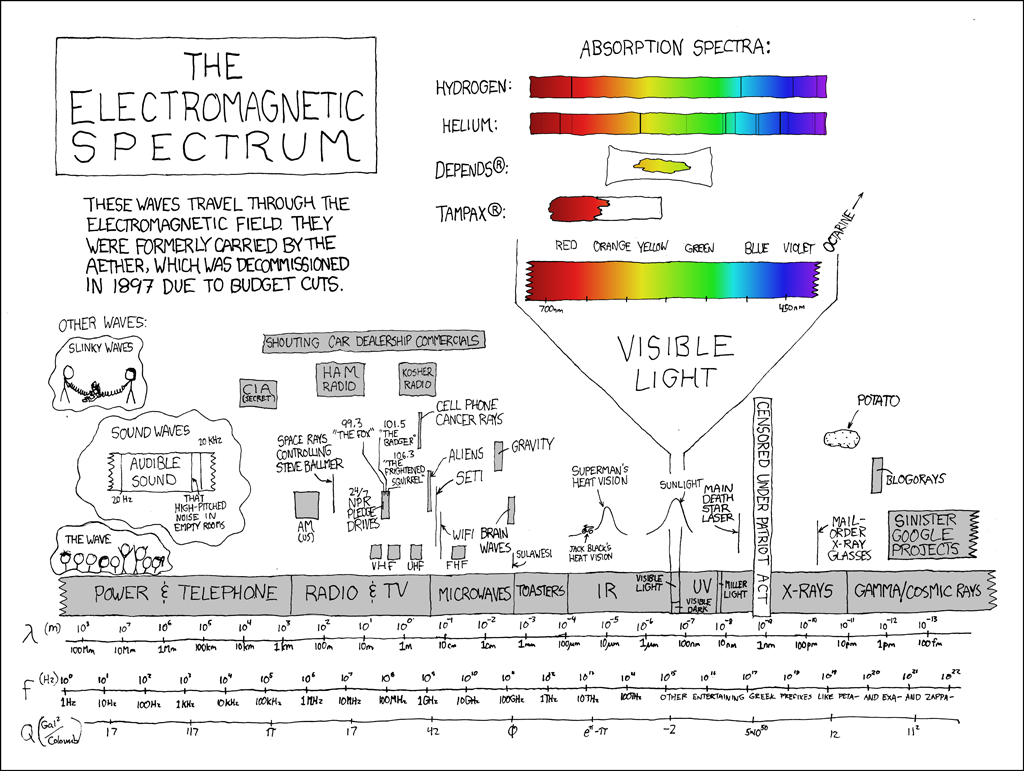
For the benefit of those who like it pictorial, look at this picture. The millimetre-wave scanners suggested for use in airport scans produce radiation in the EHF range (wavelength roughly 10 mm), while x-rays are typically about 10 million to 100 million times stronger. You would get about 0.5 to 1.5 chest x-rays worth of radiation just by flying across the Pacific, as even the EPA admits.

In short, choosing to fly already exposes you to millions of times more radiation than being scanned at airport security. Heck, they could scan Carol Felsenthal a million times and she'd still receive less radiation than she would flying from her office to her holiday home. As for privacy concerns, I'd rather pass through the scanner than be patted down.

Labels: , , ,

Wednesday, October 21, 2009

Skill-Based Technical Change

There's this loony hypothesis in economic circles that had me in stitches (especially after reading what I've been reading for the last 18 months on technological history). It's apparently a fairly entrenched idea that economic inequality stems to a large extent from technological change; the reasoning is that those with technical skills can parlay those skills into economic force multipliers or something, so they get richer faster. This is called 'skill-based technical change' (SBTC) theory.

I don't think so. That's not how technology (not itself a well-understood term) works. But apart from that, there are actually two models of technological spread that are very different, and work against the SBTC model.

Firstly, there's the 'ubiquity' model. In this model, technology spreads very quickly until everyone has the tech. This is the empirical case with many technologies — washing machines, refrigerators, toasters, radios, MP3 players, pottery, the plough, road-building, brick-making. Given a general technological level in a society, some techs will become ubiquitous very quickly. Once the coiled-coil tungsten wire technology became available, incandescent bulbs became ubiquitous within years.

Secondly, there's the 'patent control' model in which the tech originator deliberately makes it hard for the tech to become ubiquitous. But because the only way that's possible is if the tech requires a very high level of tech (e.g. stealth materials tech (and in the past, steel), requiring a large industrial base to be economically viable) or it is very arcane (e.g. stealth materials tech (and in the past, steel), which very few people understand in detail). Such tech is too expensive to give people an advantage.

Real-life examples are doctors and lawyers. The two are oft-cited examples of professional middle-to-upper class prosperity. But as my doctor and lawyer friends will tell you, the economic benefits aren't as obvious as you might think. Doctors have it worse; they tend to get sued more often and need far more supporting tech — lawyers only need information and brains.

The real money-makers often don't have a tech advantage at all; if anything, they are really good at networking and deal-making, which are social advantages. They make use of technology, but the advantage of technology is unclear at best. Any tech they do use doesn't enable them to get rich faster then the next 40% of population, simply because tech of that kind is ubiquitous tech — computerised trading systems etc. It's again brain and skill.

So is inequity accelerated by technology? I don't think so. The same people who argue for SBTC models also acknowledge that a large middle class is created by tech ubiquity, which means the bottom moves up faster than the top. Which, in turn, means technology should actually work against wealth inequity. Maybe some economist can correct me on this point.

Labels: , ,

Monday, October 12, 2009

Them 'Phones WILL Fry Your Brain

Studies have shown that using a mobile phone close to your head for ten years will double your chances of brain tumours. This is borne out by the fact that the chance of the tumour occurring is greater on the side which you normally use the phone. So far so good. At this point, the key thing we want to know is: what is the chance of a person getting a brain tumour after using a cellphone for the NEXT ten years?

You see, there is one BIG flaw in all these studies. I am 100% certain that nobody has used the SAME phone at the SAME distance from the centre of the the tumour that was found for the SAME amount of time over the SAME ten years in the SAME environment. I am willing to concede that you can control for at least one of these conditions, perhaps two, but not three or more or anywhere near all (which would include all the other things a good scientist can imagine).

In fact, since such phones use less radiation these days (the US limit is 1.6 watts/kg, the European limit is 2.0 watts/kg) and more users are resorting to hands-free connections which move the phone some distance away from the head, the risk is dropping faster than it is increasing.

So why is the title of this post so alarmist?

Well, I was just thinking about the other kinds of radiation. Radio waves are actually very low-frequency emissions that take forever to do anything to your body. At the other end of the spectrum are things like cosmic rays and gamma rays, that are even more high-energy than x-rays, and will KILL you (I was going to say KILL you DEAD, but most people get that point quite easily). You will get literally thousands of times more deadly radiation from climbing ONE mountain at high altitude or flying ONCE from New York to Singapore, than by using a mobile phone for ten years.

Actually, I cheated there. We know that cosmic radiation is deadly, but we don't know that radio waves are. We know that humans have been exposed to radio signals for decades without suffering directly-related damage from them. We know that people have turned into green superheroes died from gamma-ray exposure, and we can even watch it happening if we want.

So those phones will fry your brain, I guess, but only if you think so hard about them that you forget to shield your head from the sun, that obvious fusion-powered source of lethal radiation.

Labels: , ,

Saturday, May 16, 2009

Celliberation

Losing your cellphone is traumatic, but as my friend the Lawman said, you can retrieve 70% of the data by online means. What's cool is finding a cellphone you thought had been long lost, with a working subscription which you set aside for emergencies. There is obviously a part of me which is paranoid and used to working in the shadows.

And so I now have a working phone, and it has 50% of the numbers I had because that same paranoid me actually backed the numbers up on the phone itself, and not the SIM card in it.

I am occasionally frightened of me.

Labels: ,

Saturday, May 09, 2009

Drawing Lines (Part IIIa): Technology, History and Science

Last night the Archivist reminded me that some people like using the phrase, 'this age of technology'. I got his point at once. It's a silly phrase. I don't think there has ever been an age which wasn't an age of some technology or other.

Technologies define ages, not the other way round. While there is some dispute at this end of history, we are quite happy to name the Old Stone Age (Palaeolithic), New Stone Age (Neolithic), Bronze Age and Iron Age after the dominant material technology of a particular place at a particular time. This of course means that these ages occur at different times in different places, but the intent is clear.

Later on, of course, we see the Age of Sail, the Age of Steam, the Age of the Ironclad — all naval ideas. The Space Age overlaps the Atomic Age (which never truly came to pass except as a hope and a fear). The Age of Silicon brings us full circle; it is probably the Modern Stone Age, haha. Our history is broken up conveniently by either technologies or wars.

Then again, we have odd divisions like the Dark Ages (a strange sociohistorical construct), the Middle Ages (which people invented to fill up the space between the 'darkening' fall of Rome and the Renaissance), the Renaissance (another odd sociohistorical construct that is hard to pin down) and the Age of Revolutions (I suppose from 1776-1914 or so, what some people call the 'long 19th century'). Hobsbawm places the last between 1789 (the French Revolution) and 1914 (the First World War) though.

The thing is that history, with its ceaseless reinterpretation of empirical (and not-so-empirical) observations, its re-hypothesizing and re-structuring, does seem to resemble science a lot. It even claims some sort of predictive capability, as in Santayana's "Those who cannot remember the past are condemned to repeat it."

The line between history and science here is probably that of experimentation or technology; testing historical hypotheses by experiment is really, really difficult. It is said that some people like Stalin tried. Most people say that his was a failed experiment, whatever it was supposed to be. In Edgerton's The Shock of the Old, he innovatively divides history by difference in killing technologies. It is a sobering and gruesome perspective.

Labels: , , ,

Friday, May 08, 2009

Drawing Lines (Part III): Technology vs Science

In my last post, I drew a faint line between the Arts and the Humanities. This post attempts to draw a very similar line between Technology and Science.

I have said before that disciplines can be distinguished somewhat by looking at approach, intent, content and methodology (and perhaps output, if you substitute that for 'content' in some instances). In the Arts vs Humanities case the line is one of approach via sensory perception and resultant emotional response, intent to trigger emotional response, content that is designed to do so, and methodology of performance and display — all of which are present in the former and normally absent in the latter.

In the Technology vs Science case, the line seems clearer but is actually less clear. Technology can be distinguished from science with this guideline: it has a functional physical approach, with intent to make something as a proof-of-concept or proof-of-utility, content that is the thing made, and methodology of refining the physical presentation until the form best meets a kind of functionality — either a) the proof of concept itself, or b) the proof that the concept is useful.

There is a grey area here, of course, just as in the previous case. This grey area ranges between the bounds of what we call 'engineering' and what we call 'applied sciences'. It's relatively easy to discuss. However (and much more complicating), there is also a somewhat kaleidoscopic (from Greek kalë = 'beautiful' + eidos = 'form' or 'image' + skopein = 'to look') area which comes from the fact the 'technology' itself is a Greek word, meaning something like 'the structure of craft' or 'the study of art' or any one of a dozen other possible meanings.

You see, the Greek word technë can mean 'art', 'craft' or 'skill'; it can mean 'method' or 'making' or 'shaping'. It is a concept that has to do with the deliberate shaping of something to serve a particular function or promote a specific idea. It is, unfortunately, very much like any definition we can craft (ha) for what we referred to previously as 'the Arts'.

In recent years, the word 'technology' has been appropriated by the Sciences. But technologies existed long before science; technë precedes scientia by thousands of years. Think of the kinds of technology we've used: levers and other simple tools like the wedge and the wheel; pottery and other ceramic technologies (brick-making, glass-making); weaving and other fibre technologies (rope-making, basket-making); carpentry and woodcrafting; blacksmithing and metalworking. these are not often thought of as sciences, even though some of them may be thought of as some kind of engineering.

In many cases, once functionality has been met, the quest for more aesthetic or economic forms has continued. Brick-making becomes house-building and then architecture, before turning into urban planning.

Sometimes, new functionalities are hived off from old ones. Pottery leads to kiln design and then refractory coatings and space-shuttle protective shielding. Tile-making and glazing, glass-making and etching, eventually lead to semiconductor manufacturing.

Is this science? If anything, it is craft, that ancient and powerful Anglo-Saxon word. Humans are a crafty people; they have been so long before some of them became rational and scientific. Sometimes, it seems to me, science is only the anaemic psychobiography of the life of things and tasks. Science is like the theory of technology, although scientists prefer to think of technology as the outgrowth of science.

I look at my father's Audi and smile. "Vorsprung durch Technik," I say to myself.

Labels: , , ,

Saturday, December 15, 2007

Incommunicado

I had an amusing disconnection from technology today. I hadn't charged my cellphone, the power was cut from about 8.30 am to 5.30 pm, and I had a wedding (and the consequent dinner) on. I was AFK a lot, in other words.

The stuff people send you when you are AFK is very interesting. I am certain I lead a less interesting life than many people think I do. I quite enjoy it though when people send me messages like, "No way are you that old, surely you have MSN or something!" or "You really ought to log on more often. I have not received a reply for two days, and it's quite urgent." or "Hey! Guess what! Our book is coming out 28th December!"

The pleasures of not having to reply to a whole slew of stuff, simply because you were not around to receive it, are vastly underrated or unknown.

Labels: , ,

Saturday, June 09, 2007

The Ineffable Qualities Of Friendship

The other day I had a sudden urge to contact an old friend of mine, someone I've known for 25 years now. So I SMSed him – a short, casual message asking how he was and when he'd be in the neighbourhood. I received a reply a few hours later. He was surprised that I was asking at this particular time: he had just dreamt about the way we used to be, and he would be visiting our tiny state this very weekend.

It has been a long road. Somewhere amidst the tomfoolery, the visits to odd parts of the country, the late-night sessions, the banter about life and girls, the practical (and impractical) jokes, you can still find the thread the holds it all together. But the nature of that thread is a difficult one to perceive, let alone describe.

You see the cut-scenes, you remember the insane moments, and yet you cannot quite say what strange weapon was tempered, what familial defence was proofed, what dread chain was forged. I still remember the first long walk we took, around the shopping district. Right in the middle of it was a girls' school well known for its spirit of sincerity, courage, generosity and service. And inaccessibility. We walked around it three times before he figured out I was leading him in circles.

He demanded to know why we were doing this. Then I found the right moment and we were in the school grounds, making friends. Of course, it was a completely illegal activity. But you can't have a school in the middle of a shopping district and not have such goings-on, surely? Well, the defenders of the gate were quite serious about evicting us. Years later, he would recall that we had not appeared to make much progress in our sad little social lives, and yet... there was this incredible database.

Databases were new in that long-ago era. It is difficult now to remember just how long ago VisiCalc and dBase were, how wonderful it was to programme in Assembly, to use a Z80, to touch the face of CP/M. And there I was, assiduously keying in every little bit of data I could find, creating profiles of everyone we knew.

It was odd that nobody thought of me as a geek; it was a relief that I had enough social life not be thought of as a nerd. The database saved me, in a sense. I became a computer-assisted social coordinator in a time when this was uncommon. I wrote little programs to assess compatibility; I devised ranking formulae for acceptability and style. It was a grand endeavour, great fun, and almost completely useless. We never took it seriously, but it was serious enough to consume a fair amount of time.

And 25 years later, with high school and university and other major events behind us, what did all that accomplish? What traits, qualities, behaviours did such a life develop in those who shared this peculiar friendship? I have a few ideas.

Apparently, one of these qualities is the capacity to forge 'psychic' links. I don't mean something paranormal (or at least, I don't think so). We had no cellphones, hardly any internet capability, fast modems ran at 300 baud. It made us compensate in ingenious ways. It was a kind of information tradecraft, the ability to exchange very compressed useful information and have enough redundancy to make it work. Inevitably but inexplicably, some of us developed the ability to communicate without saying anything, or to leave the equivalent of post-hypnotic messages.

Another one of these qualities is the sense of being connected into a huge safety-net. Somehow, in any major city of the world, there is the odd sensation that resources are always available. And they are, often just around the corner. Parachuted into NYC a few years after 9/11, I met up with friends I hadn't seen for years. You turn a corner, and there they are. Walking down a lonely London lane, you find another one. It isn't something you rely on, of course; but in a sense, it has come to be something you almost expect.

These two qualities together really forged the equivalent of a universal knowledge resource. You always know whom to call when you need something esoteric or a person with the right professional skills (intellectual-property lawyer, dermatologist, uranium toxicologist, coastguard commander, and so on). The modern equivalents, I am sure, are not lacking. But I think of the odd talents we found in ourselves as the equivalent of steampunk – not quite cybernetic, but close enough and considerably more romantic.

Labels: , , , ,